U.S. Army Africa MEDFLAG 09 Medical Visit Hhohho, Swaziland 090807
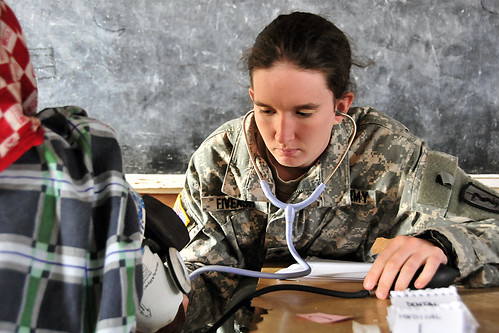
Image by US Army Africa
www.usaraf.army.mil
MEDFLAG medics provide relief to Swazi villagers
By Staff Sgt. Lesley Waters
CJTF-HOA Public Affairs
HHOHHO, Swaziland â€" U.S. military medics partnered with Umbutfo Swaziland Defence Force (USDF) and a Swaziland Public Health medical team to offer care to nearly 500 Swazi villagers during MEDFLAG 09.
The village, in the Swaziland’s Zinyane Province, was one of four villages the MEDFLAG team visited during the two-week exercise. The 35-member U.S. medical team arrived in Hhohho on Aug. 7 for a two-day visit.
U.S. Army Africa is conducting MEDFLAG 09, a joint and combined military exercise that supports U.S. Africa Command’s Theater Security Cooperation (TSC) strategy â€" which includes supporting African countries with medical capabilities.
“It very important for the Soldiers to go out and deliver healthcare into the local villages,†said Lt. Col. Michael Money, co-director of MEDFLAG 09 from the U.S. Army’s 212th Combat Support Hospital. “Hopefully, by the time we provide the final humanitarian and civil assistance event, the impression we leave with the Swazi government and its people is ‘wow, we miss the Americans’.â€
The U.S. personnel are in Swaziland at the invitation of the Swazi government and in coordination with the U.S. Embassy in Mbabane. They depart Swaziland once the exercise is complete. Before U.S. troops head home, they will provide outstanding medical and dental care to the Swazi people, Money said.
U.S. Army Capt. Julie Bridges, a nurse with the U.S. Army Center for Health Promotion and Preventive Medicine Europe in Landstuhl, Germany, provided healthcare training and education to the villagers. She worked closely with local public health leaders on the best way to share her expertise.
“It is important to teach the villagers how to take care of themselves and Capt. Bridges has shared a lot of good information,†said Swaziland Regional Public Health Matron Medy Shongwe. “We want to show them how to clean food, boil water to drink, use different buckets for clean and dirty water and ways to prevent getting sexual disease.â€
A local drama group performed several different health education skits â€" focusing how to avoid/minimize the spread of diseases.
The medical clinic was a combined effort, said USDF Lt. Col. Moses Zwane, MEDFLAG 09’s co-director.
“We couldn’t have done these humanitarian missions on our own,†Zwane said. “The U.S. couldn’t have done the missions without our USDF soldiers and the public health workers.â€
Photo Caption: U.S. Army Spc. Michelle Fiveash, 212th Combat Hospital medic, checks the vitals on a patient during the first of a two-day combined medical and dental civil assistance project (MEDCAP and DENCAP) as part of exercise MEDFLAG 09 in Hhohho Village, Swaziland on Aug. 7.
Photo by Air Force Staff Sgt. Lesley Waters. CJTF-HOA Public Affairs
Cleared for public release.
The images are generally considered in the public domain. Request that credit be given to the U.S. Army and individual photographer.
To learn more about U.S. Army Africa visit our official website at www.usaraf.army.mil
Official Twitter Feed: www.twitter.com/usarmyafrica
Official YouTube video channel: www.youtube.com/usarmyafrica
Maj. Gen. Robert Kasulke’s visit to Caserma Ederle: Army Reserve medical support March 2010

Image by US Army Africa
www.usaraf.army.mil
Army Reserve medics help U.S. Army Africa make a difference
By Rick Scavetta, U.S. Army Africa
VICENZA, Italy â€" Army Reserve medical support for upcoming U.S. Army Africa missions was the main topic during Maj. Gen. Robert Kasulke’s recent visit to Caserma Ederle.
Kasulke, commander of the U.S. Army Reserve Medical Command, wrapped up a two-day visit to U.S. Army Africa headquarters on Mar. 17. During his stay, Kasulke met with senior U.S. Army Africa staff and toured garrison medical facilities â€" to include the final stages of construction of Vicenza military community’s new health clinic.
“The point of my visit is to work with U.S. Army Africa to get Army Reserve medical personnel more involved in missions in Africa,†Kasulke said. “We have a huge pool of fully-trained and certified medical folks that we can draw from. And there are great opportunities for medical missions on the African continent.â€
Without assigned forces, U.S. Army Africa relies on support from other Army units to assign Soldiers for missions in Africa, said Col. Alfonso Alarcon, U.S. Army Africa’s senior medical officer. U.S. Army Africa needs to have a strong relationship with Army Reserve medical leaders to access Reserve medical staff for exercises, outreach clinics and familiarization events in Africa, Alarcon said.
“There are tremendous ways for Army Reserve medical Soldiers to make a difference and advance global security objectives through real-world training with our land forces partners in Africa,†Alarcon said.
Medical officers play a large role in U.S. Army Africa engagements, to include the 2009 exercise MEDFLAG in Swaziland. Another MEDFLAG exercise is being planned for central Africa this summer.
In October 2009, when a pregnant Ugandan woman arrived at a U.S. Army clinic during exercise Natural Fire 10, a U.S. Army Reserve officer â€" who happened to be a labor and delivery nurse in her civilian job in Abilene, Texas â€" helped the woman deliver her newborn son. Her efforts are one example of what Army Reserve medical staff can bring to military missions in Africa, Kasulke said.
For Army Reserve medics, taking care of patients overseas, in places that often lack quality healthcare, is a “soul-satisfying mission,†Kasulke said.
During the recent visit, Command Sgt. Maj. Roger Schulz, the Army Reserve’s senior medical noncommissioned officer, accompanied Kasulke, a vascular surgeon from upstate New York who took command of the Florida-based Army Reserve Medical Command in October 2009.
More than 28,000 Army Reserve Soldiers serve in medical roles. For several years, Reserve medics conducted training and exercises in place like Central America â€" experience that can be applied to U.S. Army Africa’s future missions, Kasulke said.
Some African medical officers are seeking help to develop better medical care, such as surgery centers and clinics. The Army Reserve has experts in establishing medical systems â€" from managers to professors â€" who could help organize assistance with that process, Kasulke said.
“The end point would be to help African partners develop systems that enable us to step back and they can carry on,†Kasulke said.
His command also has planners with experience organizing medical event that could help U.S. Army Africa staff, as the command continues to conduct military familiarization events on medical topics, where U.S. Army officers and NCOs discuss their profession with their counterparts.
Maj. Terry Clark, a U.S. Army Reserve officer, is on active-duty orders serving as a medical planner and physician assistant in the command’s surgeon office. Clark has recently led medical mentoring missions in Botswana, Malawi and Morocco.
“Working with African military medical officers offers a great opportunity for both U.S. Army Africa and the land forces of our African partner nations to build relationships that can lead to future events in the medical field,†Clark said. “We share information on how U.S. Soldiers conduct healthcare and also learn a lot about how medicine is practiced in Africa.â€
PHOTOS by Sgt. 1st Class Kyle Davis, U.S. Army Africa
To learn more about U.S. Army Africa visit our official website at www.usaraf.army.mil
Official Twitter Feed: www.twitter.com/usarmyafrica
Official YouTube video channel: www.youtube.com/usarmyafrica

No comments:
Post a Comment